
Eighty-sixth Issue! Time Dust
Welcome to February, a month suspended between frost and thaw, with a hint of romance in the air. Time feels thin here, almost brittle at the edges, as if the world is catching up to itself in slow-motion. Footsteps echo longer. Shadows stretch wider. The past, the future, and the almost-was drift closer than we’d like to admit.
Welcome to the eighty-sixth edition of the Flame Tree Fiction Newsletter.
This month’s theme is Time Dust. These are stories of fractured timelines and speculative decay. Where moments crumble away, loop, and scatter like ash. Thank you to everyone who submitted this month. Your stories bent the clock in the most brilliant ways. Ready to see what’s left in the dust?
Congratulations to both winners of the February theme: Layla Sabourian & Larry Hodges!
Time Dust Under Seven Walls by Layla Sabourian – A richly woven tale that blends myth and memory, where time settles like ash over a city full of ghosts...
KittyTime by Larry Hodges – An unsettling, deadpan spiral into routine, where artificial intelligence meets feline obsession in the bleakest of loops...
This month's newsletter features:
- NEW Flame Tree Press and Beyond & Within titles!
- Myth & Fiction Podcast
- Call for Submissions
- Original Sci-Fi Flash Fiction #1: Time Dust Under Seven Walls by Layla Sabourian
- Original Sci-Fi Flash Fiction #2: KittyTime by Larry Hodges
- EXCLUSIVE Newsletter Subscribers Special Promotion
- Next Month’s Flash Fiction Theme
FLAME TREE PRESS | February Title
Incarnate by Ramsey Campbell
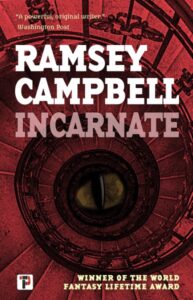
Five people take part in a study of precognitive dreaming, but the future they all dream of is a nightmare. Eleven years later, the dream creature they released creeps into all their lives in shapes they don’t realise are dreams. If it brings the five together again, far worse will be loosed on the world. Can Molly Wolfe, one of the dreamers, track down everyone involved in time to stop it, or is her search doomed to help it achieve its inhuman aim? Is she too unaware of the way the dream creature has insinuated itself into her life?

Original Sci-Fi Story #1
Time Dust Under Seven Walls
Layla Sabourian
Circa 585 B.C.E. — Hagmatāna
Night follows, settling against the seven walls: static that refuses to discharge.
It is not Yalda, the longest night of the year, yet it awaits. Snow freckles the courtyards, half-melted into slush by torchlight. Braziers burn with cedar and juniper, their smoke pooling beneath the ceilings. The heat does little to disperse the lingering chronon chill, that sharp, metallic taste in the air that clings where time has stressed and bent.
Astyagēs feels it in his teeth.
He has ruled for twenty-four years. Long enough to learn that time is not a river but an accumulating dust. It settles into stone and bone and memory. It resists.
He sits on the throne, fingers on the carved lions at its arms, and wonders if he can ever truly rule the moments he inherits.
The hall doors open.
The shepherd’s son enters behind Artemas. Torch flames stutter, their light fracturing into spectral bands. A murmur ripples through the courtiers. They have learnt, over the years, to fear such flickers.
The boy walks forward, and Astyagēs feels a prickling at the base of his skull. The old royal gift. A genetic sensitivity bred into his line, an instinct for stress fractures in the timeline.
“So”, Astyagēs’s voice cuts through the noise, “you are the king of shepherds.”
Laughter follows.
The boy bows. “It takes the greatest of kings to honor even the humblest one.”
Approval replaces laughter. Astyagēs studies him closely, so composed, so articulate. And his eyes: unsettlingly familiar, a blue so deep they drink the torchlight and pull at everything old and sore behind Astyagēs’s eyes.
A memory stirs and vanishes before he can name it.
“Explain,” Astyagēs commands. “Why, Artemas, a loyal general of mine, claims you ordered his son whipped?”
The boy does not look away. “He lost a wager of his own design, my king. He refused to pay. I enforced the rules he himself proposed. The law requires consistency. That is your message to our people, is it not?”
Astyagēs shifts on the throne, his gaze drifting, unbidden, to the sorna standing upright among the court instruments.
Dark polished wood. Forty centimetres long. Conical, flaring into a metal bell worn thin by decades of use. Seven finger holes in front, one behind. The wood was threaded with microscopic fractal growths, cultivated by years of exposure to charged chronon fields. A recorder of moments. A trap for memory.
The boy notices it too.
“If I have offended you, Great King,” he says calmly, “I will accept my punishment with dignity.”
“If?” Astyagēs asks.
“You have told me Artemas is offended,” the boy replies. “Not that you are.”
A thin smile touches Astyagēs’s mouth. He points to the instrument. “Do you play?”
“I have never tried.”
“Succeed, and walk free. Fail, and die for your impudence.”
A breath passes through the hall. Artemas stiffens.
The boy steps forward and lifts the sorna. Astyagēs notes the brief hitch in his shoulders, the subtle recalibration, as if the instrument weighs more than its size should allow. The boy’s fingers settle over the holes. He draws a breath, shallow at first, then steadier, and plays.
Sound blooms outward, reedy, then climbing, twisting. The sornas’ voice, raw and penetrating, is a double-reed cry meant for open air and ritual gatherings, for proclamations and public rites, not palace halls. Indoors, it cuts sharply. The notes press against the stone, rebound, and overlap. They vibrate through bone and mortar until the hall hums back in reluctance.
The chronon field ignites into visibility.
Excited particles shear loose from the sorna’s lattice, crystallized fragments of displaced moment hanging in the air like hard amber. The melody folds back on itself, repeating and tightening, each phrase slightly misaligned in time.
Past and present braid.
Figures resolve in the dust.
Astyagēs sees his son-in-law fifteen years back, playing the same melody the night he married his daughter, Mandana. He sees her amber-eyed, ink-stained fingers moving through the air as she calculates probabilities only she seems to see.
Dawn-glow halos her hair. Pride twists in his chest.
The dust collapses and reforms.
The boy stands again before him, the sorna trembling in his hands. Overlapping echoes linger. Mandana’s laugh, layered with harmonic remnants from a dozen moments:
A tree is judged by its fruit, Father.
He had ordered the infant taken. Sent into the wilds. Left for the chrono-flux of the mountains to scatter its future. A clean erasure. Impersonal. Necessary.
But this boy stands here. Playing the very melody that triggers memories he cannot possess.
Resonance.
The timeline rejecting its scar.
Astyagēs raises a hand. Silence crashes back into the hall. The dust sinking into stone and skin. The boy lowers the sorna, breath ragged, eyes wide with a confusion that is finally genuine.
“How?” Astyagēs whispers, descending the steps. “How can you play a Persian melody? Have you ever been there?”
“Never,” the boy says. “The wood sang to me. It showed me the way.”
The king sees it all now in the still-tingling air. A shepherd raising a child who was not his. A fixed point, stubborn and luminous.
The future forks before him.
One path ends in blood, paradox shockwaves rippling outward, unmooring Hagmatāna from its place in time.
The other bends.
He places a hand on the boy’s shoulder and feels the hum of potential: distorted but unmistakably royal.
‘You tried to break time,’ his gods murmur. ‘Now it has returned to a shape you must learn to hold.’
“The judgment stands,” Astyagēs announces. “Artemas was wrong. And this boy stays. At court. He will be taught the harmonics.”
A stir passes through the gathered lords. Artemas inhales, slow and careful.
The boy looks up.
For a heartbeat, Astyagēs sees his daughter’s light there again. Then it dims. A mind already learning how to listen for fractures in the world.
Time is never broken. The longest night, Yalda, is still coming. The dust will shift, and the prophecy is not a curse. Astyagēs knows now, but a mere convergence.
Layla Sabourian is a multilingual writer based between California and Spain. Her fiction explores themes of memory, identity, and transformation, and has been recognised in multiple short story competitions. Her work appears in The Day That Changed Everything anthology (2025), and her literary criticism is featured in Tint Journal. A National Science Foundation grantee and founder of the educational platform Chef Koochooloo, she has authored children’s books, scientific papers, and corporate white papers. Formerly a Fashion & Tech columnist for FSHN Magazine, Layla holds degrees in International Relations and French Literature and speaks English, French, Spanish, and Farsi.
Original Sci-Fi Story #2
KittyTime
Larry Hodges
Plub fondled the squirming orange tabby kitten in his appendages. It had been controversial when he’d adopted and animated it, but why not? He was the damn Director of Earth Prep for one specific Planck time. If he wanted a damn kitten, he damn sure could have one!
As a simple pseudo-being, his sole purpose was guiding the construction of this snapshot of Earth to exact specifications. His body was a gray blob of circular pseudo-matter, with appendages and sensors that popped out as needed. Every star and planet in the universe had its own director and a vast number of pseudo-workers, one crew for every Planck time—or 1043 universes for every second since the universe began, fourteen billion years ago. Take one away, and continuity collapses. Poof.
Plub felt sorry for those poor pseudo-workers in the vastness of space, destined to spend their lives painstakingly putting each interstellar particle in place. Boring. His office was in the Louvre in Paris, allowing him great viewing pleasure in his off hours.
“Meow.” The stray kitten’s eyes stared at him as if he were its whole universe. He’d named it Kittytime. He’d return it when it was time.
Time would end for them in three minutes. At that instant, the universe exactly one Planck time unit before would cascade into this one, which would then cascade into the next one, and so on, as they had since the beginning of the universe.
And he, Plub, was in charge of prepping this one planet in this one star system in this one galaxy in this one universe for this one Planck unit of time, when it would be the sole universe for 10-43 seconds.
The culmination of a life’s work.
“Meow.”
Floop barged into his office. “Sir, we have a problem.”
“Yes, Floop, what’s it this time?”
“It’s the Times Square Ball. An atom is misaligned.”
Dammit! If a single atom didn’t match up exactly with its earlier counterpart, the line of time would be thrown off. The previous universe wouldn’t mesh exactly with this one, like a key in a lock that didn’t quite fit. It would bring space-time to a continuity-crashing halt.
Not on my watch!
“Well, fix it,” Plub exclaimed.
“Sir, it’s a single atom. Most of us work in large-scale atom alignment groups. Only you and Glomp have the expertise and tendril stability to realign a single atom in the little time we have—and Glomp’s at the Himalayas finalizing Mount Everest.”
Plub stared at the ceiling. After all these thousands of years, why couldn’t his final moments be quiet ones?
“Let’s go,” he said. They shot into the air, powered by quantum energy.
Thirty seconds later, they landed directly on the Times Square Ball, surrounded by festive people frozen in their proper place for the upcoming instant. Their mouths were open as they’d started their ten-second countdown to the New Year, but they’d never reach it. He checked his pad; the previous universe would arrive in 97 seconds. He had to hurry.
“Meow.”
“What are you doing with that cat?” Floop asked.
“Petting it, of course,” Plub said. He’d forgotten about the purring kitten in his appendages.
“Sir, the ball.”
Sighing, Plub went to work. A quantum super-lens popped over his eye. He zoomed to the ball’s surface until he could see molecules, then atoms. Each atom should have been in place by now.
He compared the actual ball to the ball’s blueprints on his pad, flipping back and forth. If the atoms were in place, they’d be identical.
He saw the tiny jump of a single atom in the crystalline outer structure. The errant atom. One Planck unit off, or 6x10-34 inches.
How could this have happened?
“Sir, you need to hurry. And we need to return the cat to its proper place.”
Hundreds of pseudo-workers gathered around, watching, making Plub nervous.
He glanced at his pad. 55 seconds left.
“Meow.”
He extended a micro-thin filament. Zooming in, he found space between the properly-aligned atoms for it to move toward the errant atom.
Closer, closer, closer—
Lick.
The kitten’s raspy tongue across his pseudo-face caught him off guard. His tendril nudged an innocent atom out of position.
Dammit!
“Sir, I need to get the cat to its proper position in time.”
Grudgingly, Plub handed the kitten to his underling. They flew off.
37 seconds to go.
He frantically grabbed at the newly-errant atom, nabbing it with the tip of his tendril. He carefully pulled it back into position, barely avoiding more atoms.
Plop. The sound of an atom falling into its proper place.
23 seconds to go.
Where was the original errant atom? He’d lost his bearings!
19 seconds to go.
He grabbed his pad. Once again, he zipped back and forth, back and forth, searching—
There it was!
9 seconds to go.
His tendril slithered between the atoms like a snake in a nest of eggs. He found the errant atom.
2 seconds to go.
He grabbed it and, with a quick swipe, jerked it into place.
Plop.
Whoosh.
He felt the universes cascade past.
He checked his pad.
He’d made it by a hundredth of a second. 1041 Planck’s time units.
Whew.
His life’s work was successfully completed.
So was this snapshot of a universe, which no longer served a purpose.
The Times Square Ball went first, disassembling and fading into the dust of time. Then the people.
Plub had one more task. He shot into the air.
His body began slowly dwindling to dust.
He raced back to Paris.
There it was.
He zoomed into the animal shelter, found the cage, and grabbed Kittytime. Holding it, he walked outside to watch the universe he’d helped build crumble to dust. The warm kitten purred and stared at him as if he were the whole universe.
Which he now nearly was.
The kitten turned to dust that trickled through his tendrils like sand.
Then his tendrils faded, and the ground beneath him, and then the rest of him.
Larry Hodges, of Germantown, MD, is an active member of SFWA with exactly 250 short story sales, 66 of them "pro" sales, including six to Flame Tree, and others to Analog, Escape Pod (2), Flame Tree (6), Daily Science Fiction (3), and 19 to Galaxy's Edge. He also has four SF novels. He’s a member of Codexwriters, and a graduate of the six-week 2006 Odyssey Writers Workshop and the two-week 2008 Taos Toolbox Writers Workshop. In the world of non-fiction, he’s a full-time writer with 23 books and over 2,300 published articles in over 200 different publications. Visit him at www.larryhodges.com.
Next Month’s Newsletter HORROR Theme:
Our next edition of the newsletter will be HORROR themed, and we are looking for stories around the theme of:
Blood Moth
Please note that all stories submitted should be within the HORROR genre.
Terms and conditions for the submissions here: https://flametr.com/submissions.
Please send your 1,000-word story to the Newsletter Editor:
Leah Ratcliffe
flashfic@flametreepublishing.com
The deadline is 15th February 2026.
We look forward to reading your submissions. Happy writing!
 Sign up for our fiction newsletter